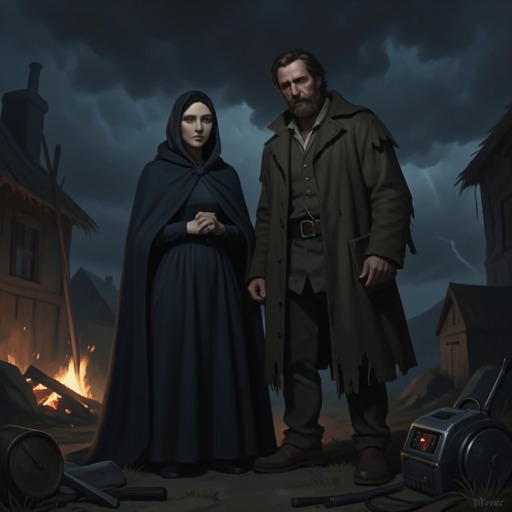
Marriage of the Duchess and the Duke of Newcastle
The Blazing WorldThe Marriage of the Duchess and the Duke of Newcastle is depicted as a lasting partnership of affection and fidelity that holds its shape across material deprivation and supernatural separation. In the narrative’s return from the Blazing-World, the Duchess’s soul speaks of her husband with tenderness and concern for his losses, while the Duke receives her reports of the Empress’s regard without resentment. Their marriage becomes the earthly anchor of her fantastic travels: riches and imperial power may be imagined, but her stated wish is to return to her husband and to the life they shared before the Civil Wars.
A Bond Measured Against Wealth
During her voyage back from the Duchess’s Native World, the Duchess’s soul asks why the Empress has not used her access between worlds to enrich her birthplace or her family. The Empress answers that she loves both, but refuses to give them gold because riches drive people to destroy one another. The Duchess counters that scarcity, not abundance, fuels that desire. Their disagreement sharpens the contrast between the Empress’s fear of wealth’s corrupting effects and the Duchess’s insistence that the material world’s poverty helps provoke its covetousness.
The Duchess does not turn the conversation into a request for herself. When the Empress offers to give her as much wealth as she desires, she says she wants no more than her Lord and Husband possessed before the Civil Wars, and would seek riches for his posterity rather than her own benefit. The Empress promises to order the Fish-men to search for a passage into the world where the Duke is; the Duchess doubts that one will be found. Even if it were, she says, she would ask not for gold or jewels but for the life-preserving Elixir from the Golden Sands. The wish exposes the limit imposed by their separated worlds: material wealth and the Elixir cannot cross between them as souls can.
Separation, Return, and Mutual Regard
The narrative makes the Duchess’s absence a spiritual rather than a permanent marital separation. Her soul accompanies the Empress on a journey that involves encounters with foreign monarchs and their subjection to tribute, while her husband remains in his own world. The Empress offers to make the Duchess as powerful a monarchess as herself, but the Duchess’s response centers on the value of the Empress’s love, which she esteems above everything in Nature. The offer of sovereignty cannot replace the relationship she already has.
When the Empress returns to the Blazing-World, the Duchess’s soul asks leave to go back to her Lord and Husband. Before she departs, the Emperor invites her to see the stables and riding houses he has built during the Empress’s absence, modeled on her account of the Duke’s own establishments. Asked about their design, she calls them plain and ordinary, adding that her husband would make them as noble as possible if he had the means. The Emperor’s magnificent buildings thus become an indirect portrait of the Duke’s straitened circumstances—and of the Duchess’s continued pride in what he might accomplish.
After the Duchess returns to her body, she tells her husband what happened abroad, including the Empress’s favorable descriptions of him to the Emperor and the campaign that brought tribute and homage to the ruler of the Duchess’s Native World. She also describes the Emperor’s stables and the horses of the Blazing-World, whose coats and skins were smoother and more lustrous than satin. If a passage existed between the worlds, she says, the Duke could have some of the horses and building materials, as well as enough gold that she would not begrudge his generous gifts. The Duke answers with a smile that he regrets the absence of a passage and has always found an obstruction to his good fortunes. The exchange joins affectionate teasing to an unsoftened recognition of what their lost prosperity means.
Fidelity Across Worlds
The marriage is framed not as a means of securing wealth or rank but as a personal attachment that survives both. The Duchess is willing to imagine her husband supplied with splendid horses, materials, and riches, yet repeatedly distinguishes his welfare from her own desire for riches. Conversely, the Duke hears her account of the Empress’s praise and her extraordinary adventures without any stated rupture in their bond; she returns to him, and he listens when he wishes to hear such discourses. Their closeness is conveyed through these ordinary acts of return, conversation, and shared recollection rather than through a dramatic reunion scene.
The narrative’s philosophical account of spirits also clarifies the unusual form their separation takes. In discussion with the Empress, the Immaterial Spirits say that they cannot move without corporeal vehicles, that pure spirits are immovable, and that natural matter, life, and form are inseparable. The Duchess’s travelling soul is therefore treated within a story that probes the boundaries between embodied and immaterial existence, not as a break from the human attachments that define her. Her journey permits her to cross worlds, but the marriage remains oriented toward the Duke’s world and her return to her body and husband.
The Marriage as the Enduring Center
The Duchess’s concern for the Duke’s fortunes is set against the scale of the Empress’s imagined power. The Empress governs a whole world yet, as the Spirits observe, can enjoy only a part of it; the Duchess, by contrast, gives her longing a concrete domestic focus in her husband’s former prosperity, his stables, and the horses she would bring him if the worlds could be joined. Imperial grandeur remains spectacle, while the marriage supplies the emotional measure by which abundance is valued.
That emphasis does not erase material hardship: the Duchess explicitly recalls the Duke’s condition before the Civil Wars, and he describes good fortune as obstructed. Instead, the story lets loyalty persist without pretending that affection restores what has been lost. The marriage’s decisive feature is its continuity across distance: the Duchess’s soul returns to her body and her husband, carries the Empress’s commendations back to him, and shares with him both the wonders she has seen and the limits that prevent those wonders from becoming possessions in their world.